A favourite theme in Embroidery
Flowers and foliage have been a favourite theme in embroidery for centuries. During the early Middle Ages embroiderers and painters worked together to create flower motifs and then when science introduced perspective to art, the plant drawings became more realistic. Design entered the picture and abstraction flattened the flower in a kind of a cross section view. Folk art kept the floral artform alive by continuing to use the traditional motifs that we still love today. Traditional embroidery and the old plant designs are still valued in China, India, Morocco, Scandinavia, Mexico and other countries like Australia and England and can be found in the home today as furnishings.
How the Ideas Spread
Artists and embroiderers have always changed designs to suit their materials. As a result, designs were adapted to local needs and moved from one country to another.
Ideas and plant motifs spread with trade, the Crusades, and the spread of Christianity.
- Ecclesiastical embroidered garments made of silk,
- Greek tunics and togas,
- Chinese stitched flower symbols on silk
- Nuns teaching in monasteries and in missions
Embroidery patterns were adapted to suit different fabrics and the needs of the day. Flower motifs became stylised to suit the stitches, and simple shapes were best for needle and thread.
Tree of Life design
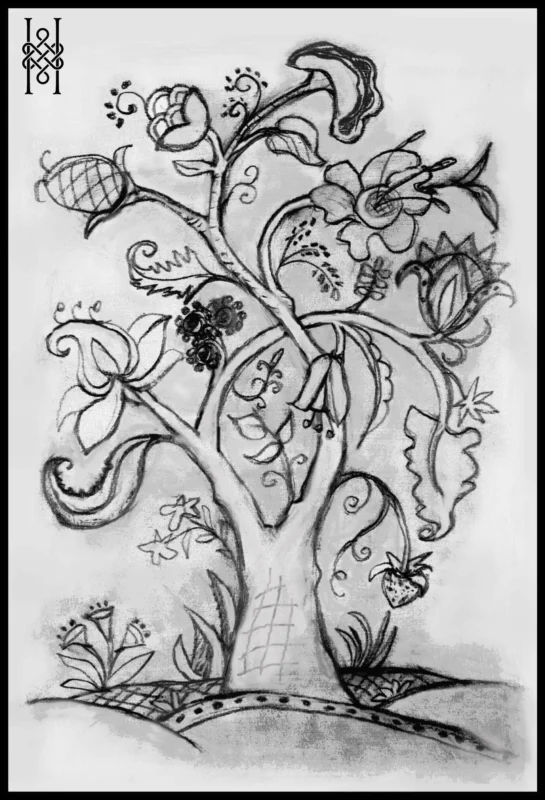
My Charcoal drawing of a Tree of Life in the field
From the sixteenth century different techniques developed all over Europe. Printed oriental cottons influenced seventeenth century Jacobean embroidery in England and a Tree of Life theme developed. The Jacobean style which mastered the Tree of Life design became popular. The trees were hybrid with many varieties of English garden flowers combined onto one tree. They were placed on mounds representing the countryside and landscape. Some designs were placed on decorative hangings.
By the end of the nineteenth century there was a revival of interest in the flower motif with William Morris and his company Morris & Co. The Tree of Life was still prominent. Flowers and especially the artichoke became more realistic and were used as motifs on wallpapers. Flowers, leaves, tendrils, spirals and curvilinear celtic style decorative motifs covered and stretched into coloured spaces and shapes, sometimes with small creatures hiding in the foliage.
Jessie Newberry at the Glasgow School of Art taught embroidery and her style later morphed into Art Nouveau with the free-flowing spirals and elegant lines in linen applique works.
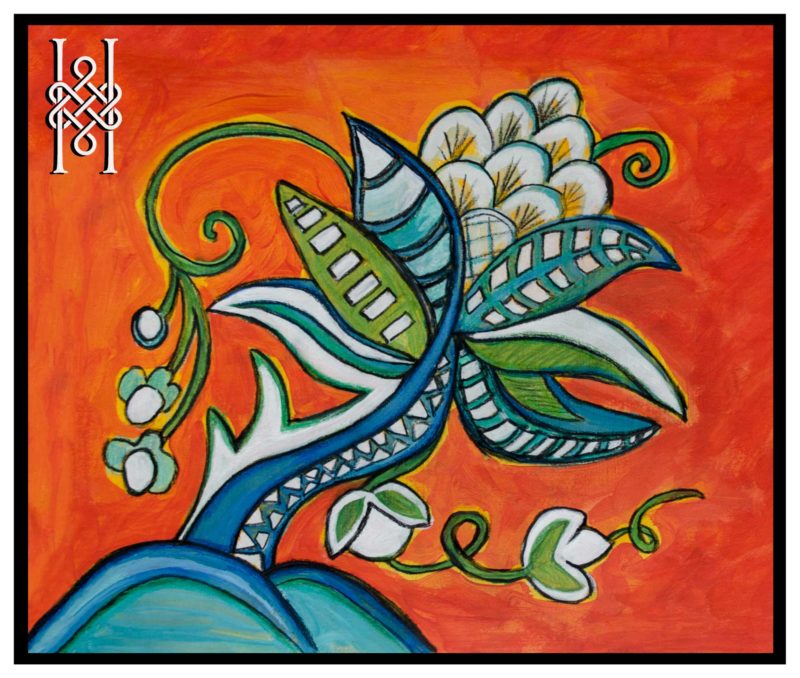
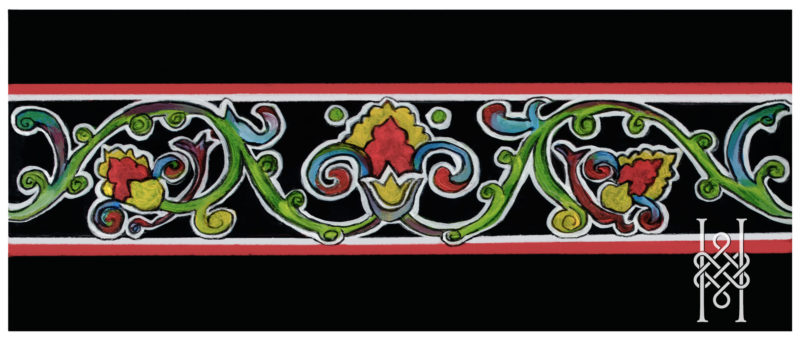
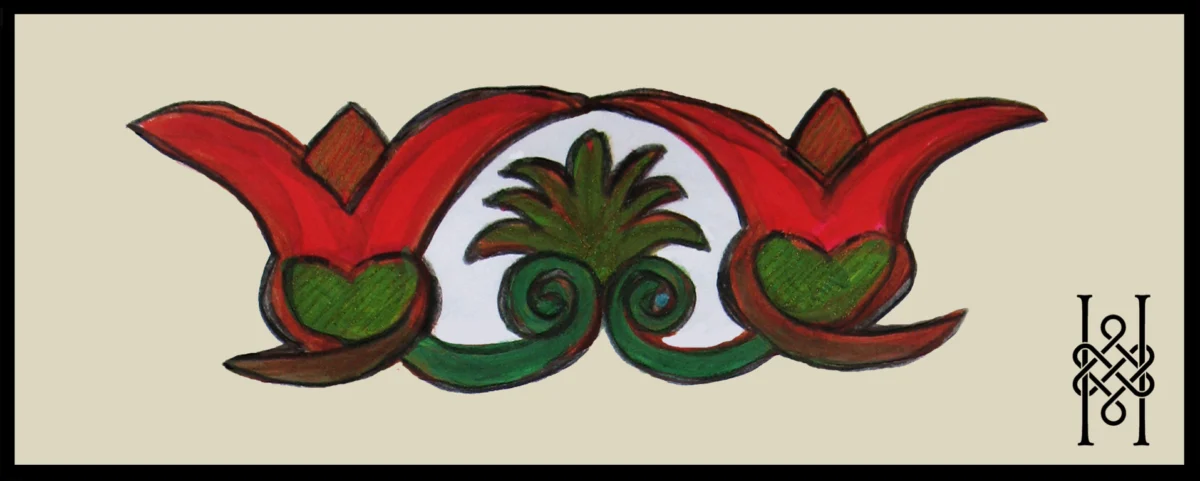
In the border design, at the top the natural blossom has been rendered into an exotic Jacobean style flower with small spiral leaves or buds. It is not a copy from nature but a stylized semi-abstract motif. Influences are multicultural and the pattern is repeating.
Noticeable design influences are the lotus flower and palmette combination from early Celtic, Egyptian, Greek and Roman art. A typical lotus and palmette design is shown above.
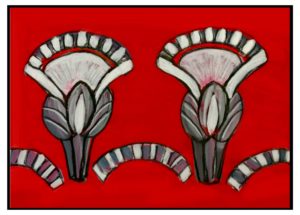 The early trumpet shape Lotus motif from Egypt
The border design at the top of the Post is symmetrical and can be used as a border in embroidery, wood carving, pottery or painting. Lines and shapes repeat in a curving, reaching stem or as tendrils with leaf scrolls. The design moves in a rhythmic wave across the strip border. Flowers as motifs like this are great to use in floral patterns and open designs for whole walls or on fabrics.
A love of plants and flowers from the natural world never dies. Botanical illustrations record the exact details and photograph likeness from observation, but floral and foliage art from embroidery can express a connection to nature in a different way. It moves into the field of colourful creative design and pattern that celebrates plants and their unique beauty.
The border design, the charcoal drawing of the tree and the motifs above are my painted drawings. This page can be printed for education purposes.