The Power of Rome
Rome and Classical Art are celebrated and represented as the birthplace and centre of Western Civilisation. As a result, other cultural achievements are not given the same authority. For an extended period sadly, Celtic art was hidden or rather, ignored. It was known as Animal Art.
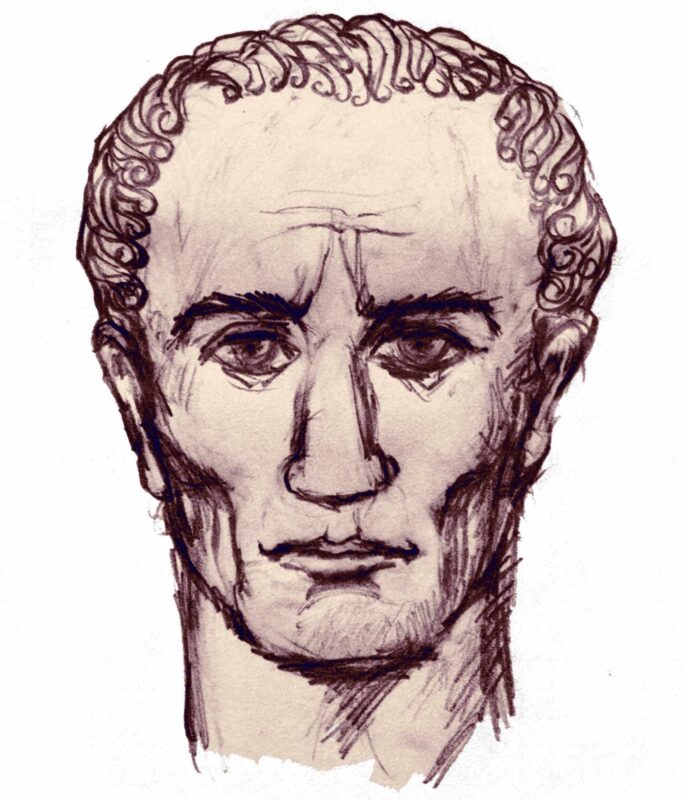
When we think of Rome we think of the Empire and Emperors. We think of the time before the Empire when Julius Caesar as a Consul was one of two advisors leading the Senate and government. Rome in those days was a Republic. After Caesar, Rome became an Empire and Emperors with huge armies marched across Europe to invade and take over new territories. It was a war machine mostly on foot and with thousands of soldiers marching in tidy military lines in boots and helmuts across Europe.
A long time before Odoacer conquered Rome, Julius Caesar was betrayed and murdered by the Senators. Augustus, known as Octavian, his stepson, was the first Emperor of the new Roman Empire.
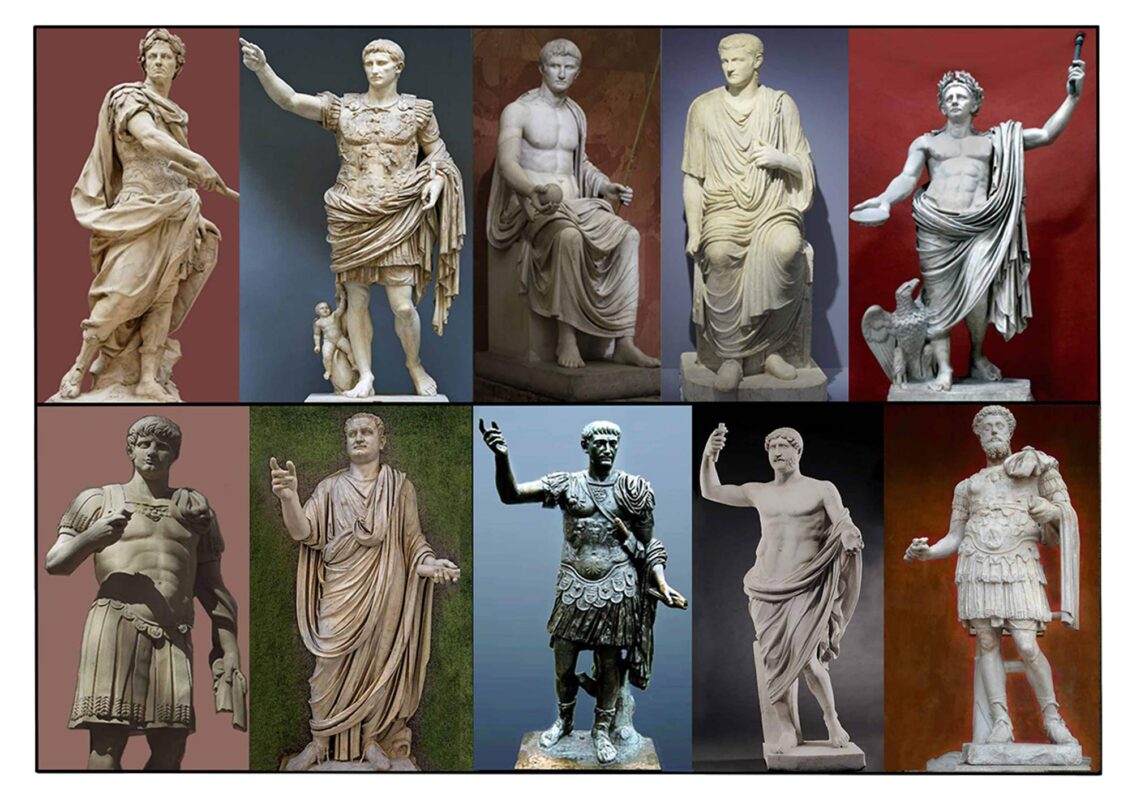
From top first. Left to right Top: Julius Caesar, Augustus (Octavian), Tiberius, Gaius Caligula, Claudius. Bottom: Nero, Titus, Trajan, Hadrian, Marcus Aurelius.
Only a few early emperors are shown in the image above.
These are Classical style statues that turn Generals into heroes and Gods. We look ‘up’ to the men on the plinths and this gives them a visual real world power. They are often larger than life and we are small looking up at them. The perfection and idealisation of the human figure in marble and stone makes them immortal. Classical art reinforced the triumph of war by erecting statues of the emperors.
The Roman legions, many of whom were soldier slaves in the Auxiliary were tired after endless battles. They wanted a better life and rewards like land for themselves. The western Roman Empire based in Italy finally collapsed in 476 AD with the sacking of Ravenna. It was sacked by the united Barbarian (Germanic) tribes led by Odoacer (Odovaker). A new era of history began and Classical art went underground for the next one thousand years in the Middle Ages. The old Empire shifted and survived in Constantinople in the east and Christianity was legalised in government.
Classical Art centered around the human figure. The Romans were influenced and mostly copied Greek ideas and art. The Greeks were poets and philosophers whereas the Romans were more technical and like the armies were disciplined and mechanical. It was an art of the conservative ruling classes, and it was photo realistic and straightforward. (These ideas are a quote from Simon Schama, BBC documentary Civilisations Series following on from the earlier Kenneth Clark Civilizations series).
The Middle Ages
The change and breakaway from Classical thinking is also called the Dark Ages (500 to 1500 AD) or Early Middle Ages by historians. It began with the Fall of Rome in 476 AD and lasted for about one thousand years. When the western Roman Empire collapsed in Italy the old Empire continued in the East and art and culture moved in a different direction. Another period of art called Byzantine and Romanesque developed in this location.
In the Middle Ages wars and chaos continued in Europe for centuries. There was no centralized power or government to rule over Europe and around the Mediterranean fringe as before. The old Empire had expanded and contracted. Now ancestral people reclaimed land, migrated, and spread further over Europe, something the Romans had done themselves. Europe was unsettled for a long time and the monasteries became centres of learning.
Rome as the capital was sacked twice, first by the Visigoths led by Alaric in 410 AD and second by the Vandals in 455 AD. Rome was plundered and mostly destroyed.
The Fall of Rome
On the third occasion in this fifth century, Rome was taken over by Germanic tribes led by Odoacer (Odovakar) in 476 AD. The plundered imperial city had moved to Ravenna and the huge Roman Empire was split in two as East and West. It was decided that both Empires have only one Emperor resident in the east at Constantinople (Istanbol). A deal was made. Italy no longer had an Emperor but a King with Odoacer now in command of government in the Western part of the old Empire. In the East at Constantinople a residue of the Empire survived as the Byzantine Empire.
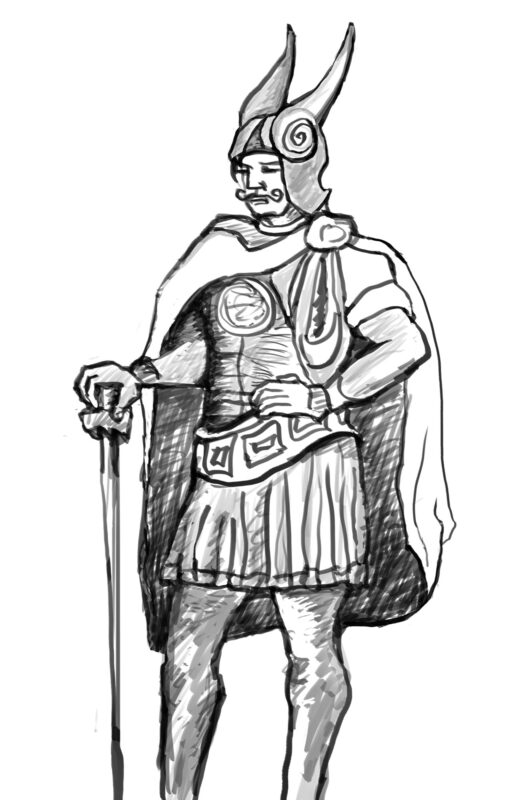
My drawing of Odoacer is an adaptation taken from an Illustration from 1880 of Odoacer deposing Romulus. The helmet has wings and reminds me of a modern-day Super Man with a cloak and bare legs.
Romulus Augustus was the last Roman Emperor; he was sixteen and a puppet for his father Orestes. Odoacer deposed Romulus. Odoacer became a popular King and ruled the old Western Empire for another seventeen years.
European Tribes
The Romans called the travelling Germanic tribes Barbarians. Barbarian refers to non-Latin or Greek speaking people from outside the Roman Empire. The main barbarian tribes were the Celts, the Franks, Vandals, Ostrogoths, Visigoths and later the Huns who drove the Goths from the North. Europe was unsettled for a long time.
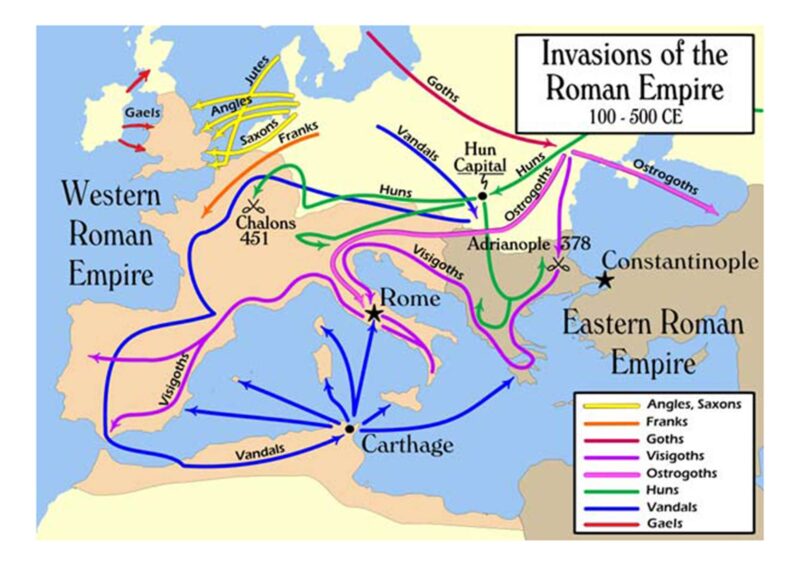
Wikimedia Map of the “barbarian” invasions by the Angles, Saxons, Jutes, Franks, Goths, Visigoths, Ostrogoths, Huns and Vandals of the Roman Empire showing the major incursions from 100 to 500 CE.
It was the Italian scholar Petrarch who labelled this period as a Dark Age, as opposed to the light of the Classics. The darkness for many however, was the slow rise in power of the Roman Catholic Church, the emerging feudal system, and the Bubonic Plague which killed millions. The Church became more powerful than the State and the Pope rose to the top of the power pyramid.
Only later did the art of the Celtic people, or barbarians as they were known, take a place on the stage. Only after the power and dominance of Rome was crushed and other cultures could stand alone outside the Classical world.