Incredible Birds and Dogs
The Medieval monastery artists were ahead of their time. In this Post I have added three Zoomorph images that show the interlace style and imaginative design used by the monks.
Animal and bird drawings in the Medieval manuscripts like the Book of Kells are called zoomorphs. Church Rules forbade real life representations of living things and so the birds and animals were stylized. They became interlaced motifs, sometimes in mirror pairs as shown below in the Tree of Life with two birds. These images of the dogs and the birds are not naturalistic like a photograph. The drawing of the eyes with a black dot in the centre produces a stunned and hypnotic expression which adds intensity.
The drawings of animals and birds as zoomorphs were wrapped around shapes and lines; they were abstracted and complex interlaced designs. Sometimes the creatures were there to represent symbols for human ideas or people. Similar to the idea of totem animals in tribes and clans in some cultural beliefs. In Christian art the fish is a symbol of Christ, and the lion is a symbol of the evangelist Matthew in the manuscripts.
Zoomorphism In the Book of Kells a zoomorph can be a symbol for something else. The Apostle Mark is represented by a lion, Luke by a calf and John by an eagle. None of the animals were drawn realistically, their bodies were distorted, limbs extended, and interlaced, but they were still a symbol that could be identified. For example, they still had the mannerisms and characteristics of the lion, calf or eagle. Zoomorphs do not have human body parts like the sphinx from Egypt. The interesting aspect is, that a dog remains as a dog even although the drawing is not realistic but heavily distorted and reconstructed. Brilliant abstractions from real life by the monks.
Anthropomorphism This is when animals and objects are drawn with some human body parts or characteristics. Sometimes a human voice and words are present. Creatures take on human gestures and intentions and possess some part of the human body. Examples include the sphinx – a hybrid with eagle wings, lion’s body and human head, or a centaur with the head of a human and body of a horse, or a minotaur with a human body and the head of a bull, or a satyr (faun) with both human and goat features. Popular animal cartoons like Walt Disney characters and many others, are an obvious example of anthromorphism with the added human voice. Humans like cute smiles and gestures that remind them of themselves.
In contrast medieval manuscript creatures as zoomorphs are unique. They are not cute or sweet and the expressions and mannerisms are not cuddly and commercial. They are likeable even if they are a bit quirky and not real. The zoomorphs from the Book of Kells are shown below as birds and a pair of dogs.
Bird Zoomorphs
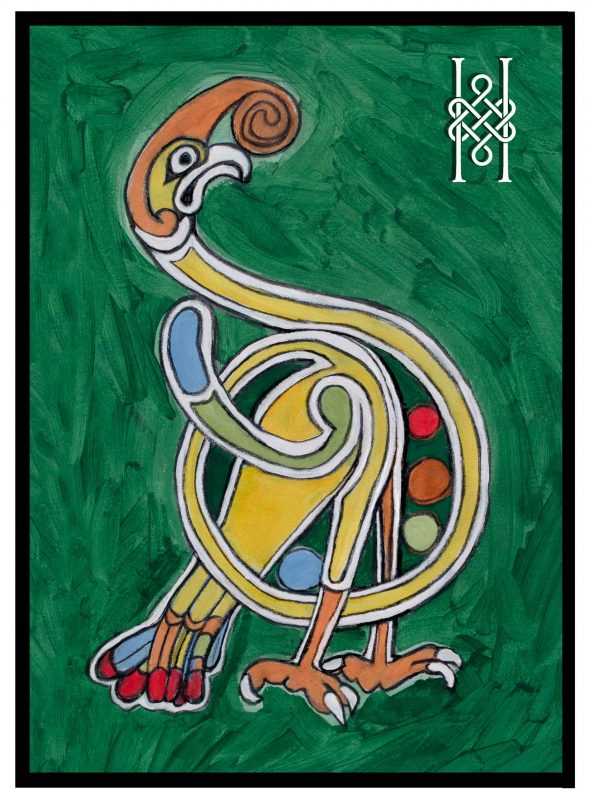
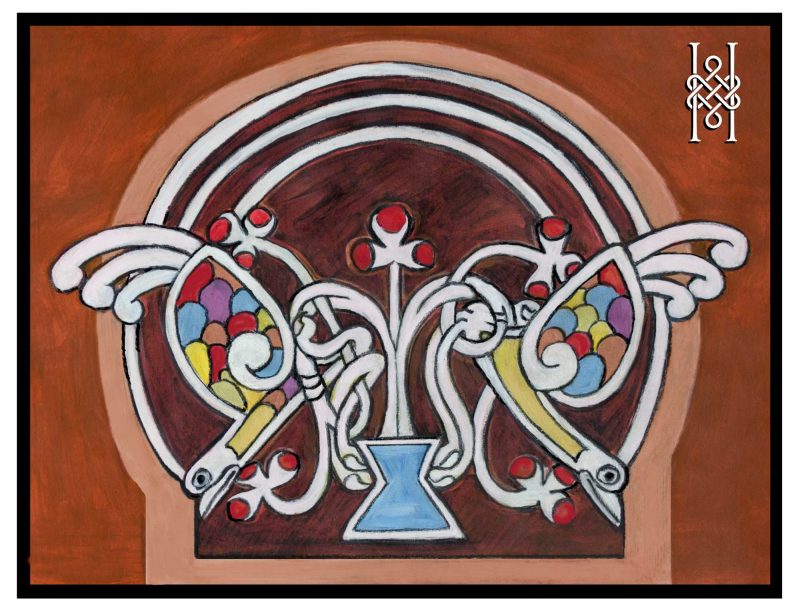
Birds were combined with the letter in this interlacing style. The first zoomorphic drawing shows the bird wrapped in the simple small or lower case letter d. The second image here, shows two birds in a tree with the Tree of Life Book of Kells’ interlaced style. The tree grows out of a pot, a symbol of the trunk and roots of a tree. Even the leaves have been created new to look like three bunched skittles. The artist monks were incredibly creative and fitted the drawings into unusual shapes and spaces everywhere on the manuscript carpet page. This is an amazing interpretation of the the Tree of Life with the symmetry of the birds and the clay pot. Other more complex shaped letters use animals such as lions and snakes and can be seen in the Animal Letters Post.
Dog Zoomorph
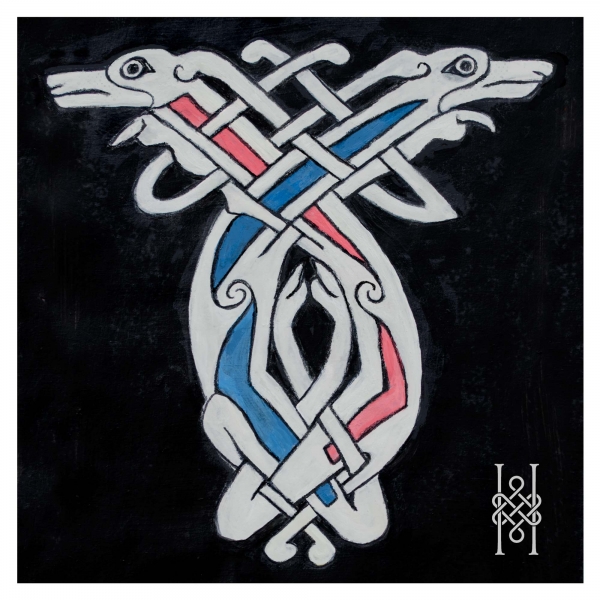
The third image is from the Lindsfarne Gospels and shows a dog pair on black background, interlocked together in symmetrical harmony. The legs and paws are locked and entangled in an interplay of impossible gymnastics. Sometimes the quadrupeds hold and bite their own or other creature’s limbs, and this is thought to represent the carnivorous diet or animal play.
Zoomorphs from Medieval manuscripts by the interplay of positions, limbs and interlace in complex designs have something far beyond the simple observation skill of rendering a drawing as a photograph. These animal zoomorphs grew from various influences such as Viking and/or Asian Eastern art. The designs grew in artistic steps from animal illustrations in the Book of Durrow and the Lindisfarne Gospels and eventually matured in style in the Book of Kells.
Abstraction, imagination, and design are the next brave steps beyond observation and copying skills. Besides, the monk artists were limited by the Church rules. Imagine not being able to draw animals from life as they are.
The monks may have been limited by Church rules but they were not limited in their imagination.
The drawings are made to illustrate the text and can be used as examples. Pages can be printed out for education purposes.