Tricks and Devices in the Eagle Drawing
The Book of Kells lets us in on many artist tricks and devices. The monks have flattened this image of the eagle as a symbol of St John into big shapes and kept the body parts semi-realistic.
Is the bird moving to the left or flying upwards? The diagonals form a cross but the legs and top notch create a vertical. The underlying skeleton of a drawing is a powerful tool. The conflict in directional pull makes the bird stationary. It is an amazing drawing that manages to maintain a balanced composition.
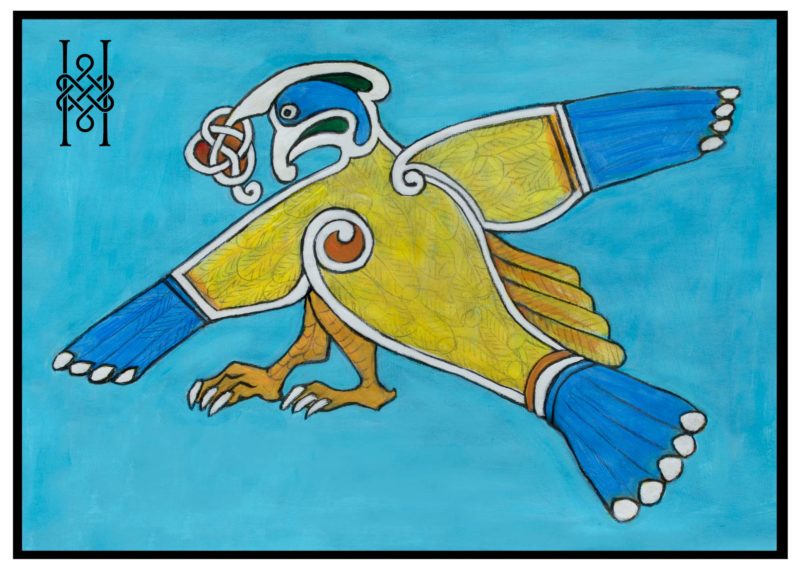
This eagle was shown in the Book of Kells as a symbol for the Apostle St. John and is like a drawing from the Book of Armagh. In a clever design arrangement, the eagle’s feet walk along the top of some letters of a word in this folio page of the Book. (Folio 21.2V)
Skeleton Framework
Gestalt is a sub conscious compostional tool that some artists use to keep the eye of the viewer locked into the frame. It is a device that can be used to add expression and movement to the flat two-dimensional drawing. The idea is to keep the eye of the viewer circling in the frame. Knowingly or unknowingly, it is an interesting device that is based on the psychology of visual perception. It is basically controlled by the reading from left to right on the page in the West, the other way round in the East. For now, I will try to outline the flow in this picture. Outside the frame on the left is the past. Outside the frame on the right is the future. Above is the Sky and empty space and below is the Earth and cluttered space.
Spirals and scrolls have directional flow. The wing on the right side is pushed outward by the small scroll and continuing line to the right, ascending. The left wing because it is lower, points downward and descends. The tail feathers go down to the bottom left corner. The feet move to the left and to the past. The knotwork topnotch drops down by the force we know subconsciously as gravity. All of this keeps the bird grounded. Look at other pictures yourself and see which way the pull of compositional arrows goes in the frame.
Balance and Composition
The amazing flattening and profile view in the design shows every part of the bird by position and placement. Still proportionally correct but not true to perspective. Not unlike the accomplishment of Egyptian art with the face profile and front in the same drawing. The delightful bird topnotch in a Celtic knot formation flops over the head. The use of white as an outline adds a flat graphic art quality. Light pencil lines inside the body shape suggest feathers. Expression comes from the eyes showing a small black dot (stunned and staring) and the curve of the beak. Although simple, these marks never cease to amaze me. I am not sure whether the top knot hanging over the head is funny or deadly serious- it is playful and strange because it is not real. What do you think?
The drawing is made to illustrate the text and can be used as an example. This drawing is not exactly as it is in the Book of Kells in colour or execution. This page can be printed out for education purposes.